
Nerve Agents
As for Poison Gas and Chemical Warfare in all its forms...only the first chapter has been written of a terrible book.
Winston Churchill.
Nerve agents interfere with nerve impulse transmission. They are a class of phosphorus containing organic chemicals (organophosphates) that disrupt the mechanism by which nerves transfer messages to organs. The disruption is caused by blocking acetylcholinesterase, an enzyme that normally destroys acetylcholine, a neurotransmitter. They are related to DDT. They are the most toxic of CW agents.
Nerve agents are now divided into three series:
- The G-series is named because German scientists first synthesized them. G series agents are known as non-persistent, while the V series are persistent. The first nerve agent synthesised was GA (Tabun) in 1936. GB (Sarin) was discovered next in 1939, followed by GD (Soman) in 1944 and finally the more obscure GF (Cyclosarin) in 1949.
- The V-series were developed in the 1950s. Workers at ICI in the UK were looking for new organophosphorous pesticides. In 1954, ICI put one of them on the market under the trade name Amiton. It was subsequently withdrawn, as it was too toxic for safe use. The toxicity did not go unnoticed and some of the more toxic materials had in fact been sent to the Chemical Defence Establishment at Porton Down for evaluation. After the evaluation was complete, several members of this class of compounds became a new group of nerve agents, the V agents (depending on the source, the V stands for Victory, Venomous, or Viscous). The best known of these is probably VX, with the Russian V-gas coming a close second (Amiton is largely forgotten as VG). This class of compounds is also sometimes known as Tammelin's esters, after Lars-Erik Tammelin of the Swedish Institute of Defense Research who first synthesised a number of the agents.
- The Novichok (Russian for "newcomer") agents are a series of organophosphorous compounds that were developed in the Soviet Union from the mid-1960s to the 1990s. The goal of this program was to develop and manufacture highly deadly chemical weapons that were unknown to the West. These new agents were designed to be undetectable using standard 1970s and 80s NATO chemical detection equipment; to defeat NATO chemical protective gear; to be safer to handle; and to circumvent the Chemical Weapons Convention list of controlled precursors, classes of chemical and physical form.
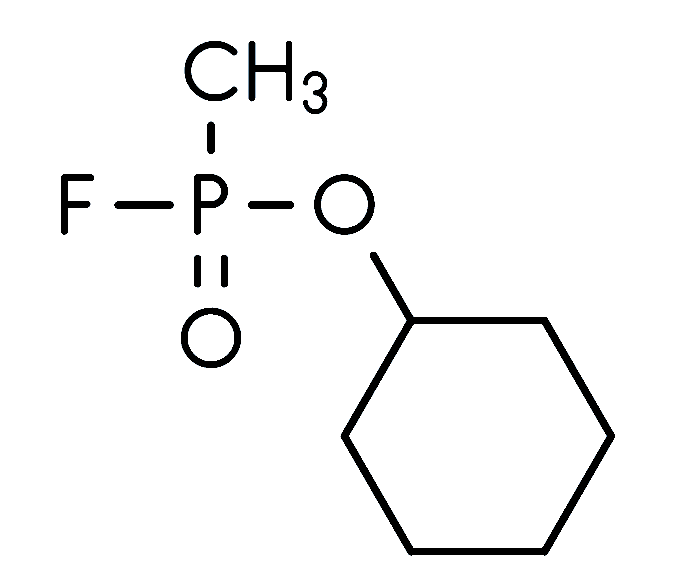
Cyclohexyl methylphosphonofluoridate [Cyclosarin, GF] - C7H14FO2P
A colorless liquid, odourless
to fruity odour, possibly of peach. Cyclosarin is readily absorbed
through skin, eyes, and respiratory tract with inhalation and
dermal routes of exposure posing significant threats. It is more
persistent and less lethal than its nerve agent predecessor,
Sarin. Toxic manifestations of exposure to cyclosarin vapor or
aerosols occur within seconds to minutes of inhalation, while
signs and symptoms of percutaneous exposure to liquid cyclosarin
may take a minute to hours. Initial symptoms will vary depending
on dose and exposure route. The following is a general list of
possible symptoms. The severity of effects depends upon the dosage
and exposure type. Vapour, small dose: Reduction in pupil size,
dimness of vision, runny nose, tightness of chest, difficulty in
breathing, headache, and salivation. Time of onset: seconds to
minutes after exposure. Liquid on skin, small to moderate
dose: Sweating or muscle twitching at site of exposure, nausea,
vomiting, feeling of weakness. Time of onset: 10 minutes to 18
hours after exposure. Moderate to severe: Vapor, large dose:
All of the above, plus sudden loss of consciousness, convulsions,
temporary cessation of breathing, paralysis from reduced muscle
tone, copious nasal secretions, increased miosis (to level of
pinpointing of pupils). Liquid on skin, large dose: All of the
above, plus sudden loss of consciousness, convulsions, temporary
cessation of breathing, paralysis from reduced muscle tone,
copious nasal secretions, diarrhea. Severe: All of the above, plus
severe breathing difficulty or cessation of breathing; generalized
muscular twitching, weakness, or paralysis; convulsions; loss of
consciousness, involuntary defecation and urination, coma, death.
Vapor, time of onset: seconds to minutes after exposure; Skin,
time of onset: minutes to an hour after exposure.
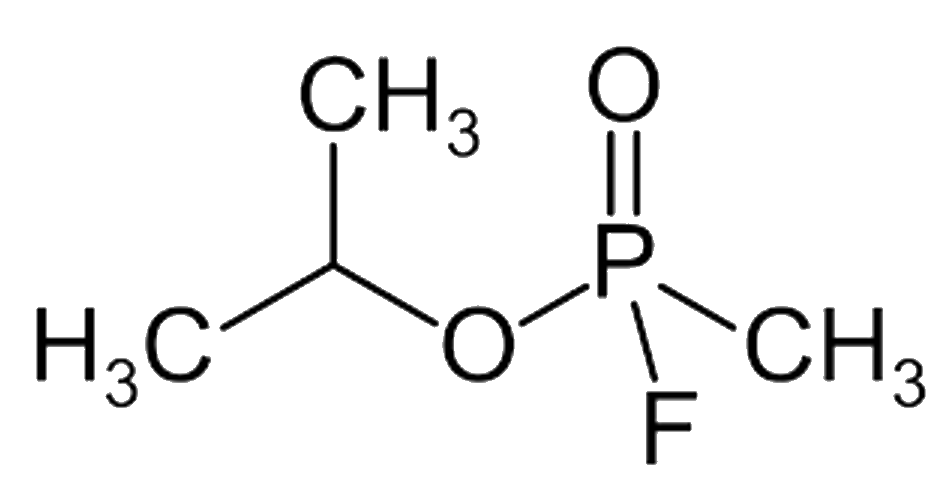
Isopropyl methylphosphonofluoridate [Sarin, GB] - C4H10FO2P
In the pure form a colourless,
odourless liquid. Exposure is lethal even at very low
concentrations, where death can occur within one-to-ten minutes
after direct inhalation of a lethal dose, due to suffocation from
lung muscle paralysis, unless antidotes are quickly administered.
People who absorb a non-lethal dose, but do not receive immediate
medical treatment, may suffer permanent neurological damage. Signs
and symptoms depend on the amount of sarin, how the person was
exposed, and for how long. Sarin has no smell, so people may not
know they were exposed until signs and symptoms develop.
Exposure to a low or medium amount may cause some or all of these
signs and symptoms within seconds to hours: abnormally low or high
blood pressure, blurry vision, chest tightness, confusion, cough,
diarrhea, nausea, vomiting, abdominal pain, drooling, difficulty
breathing, shortness of breath, wheezing, drowsiness, eye pain,
lachrymation, excessive sweating, headache, increased urination,
muscle cramps, rapid breathing, runny nose, low or fast heart
rate, small pinpoint pupils, tremors, weakness.
Even a small drop of sarin on
the skin can cause sweating and muscle twitching where it touched
the skin.
Exposure to large doses of sarin by any type of exposure would
likely cause the following harmful health effects: loss of
consciousness, cardiac arrest possibly leading to death, coma,
convulsions, paralysis, respiratory failure possibly leading to
death, seizures, muscular twitching.
O-butyl S-[2-(diethylamino)ethyl] methylphosphonothioate [Chinese VX, EA-6043] - C11H26NO2PS
A structural isomer of VX. It is an organic thiophosphate that is an ester of S-[2-(diethylamino)ethyl] O hydrogen methylphosphonothioate. A toxic nerve agent developed by the Peoples' Republic of China. It has a role as a neurotoxin and an EC 3.1.1.7 (acetylcholinesterase) inhibitor. It is an organic thiophosphate and a tertiary amino compound.
Symptoms of exposure include:
rhinorrhea, salivation, sweating, lachrymation, abdominal
cramping, vomiting, and diarrhea are prominent symptoms,
respiratory distress is caused by increased respiratory secretions
and bronchospasm Overstimulation of the muscarinic system
causes bradycardia (abnormally slow resting heart rate).
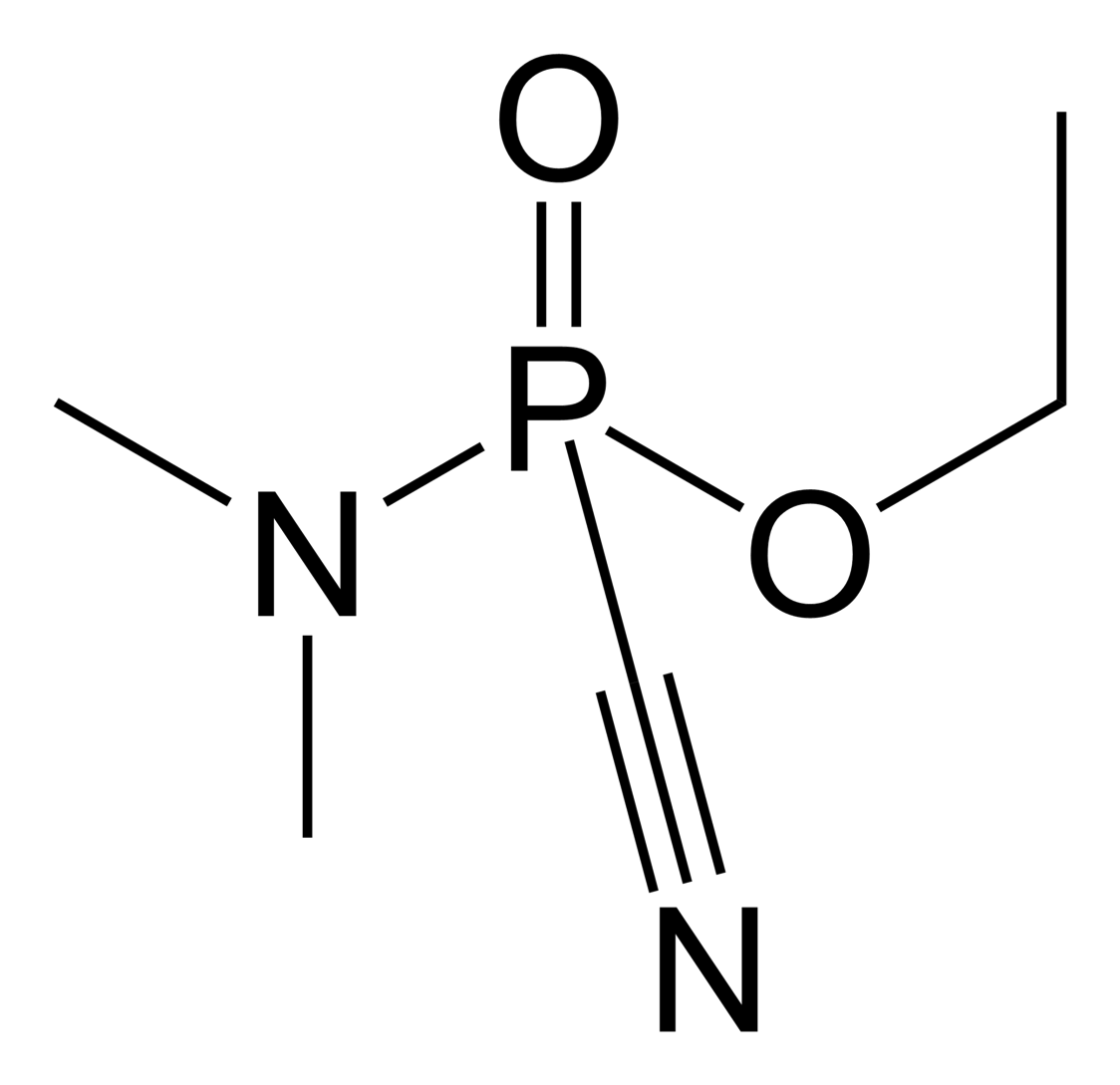
O-Ethyl N,N-dimethyl phosphoramidocyanidate [Tabun, GA] - C5H11N2O2P
A clear, colourless to brownish, and tasteless liquid with a faint fruity odor. The symptoms of exposure include: nervousness/restlessness, miosis , rhinorrhea, excessive salivation, dyspnea, sweating, bradycardia, loss of consciousness, convulsions, flaccid paralysis, loss of bladder and bowel control, apnea and lung blisters. The exact symptoms of overexposure are similar to those created by all nerve agents. Tabun is toxic even in minute doses. The number and severity of symptoms which appear vary according to the amount of the agent absorbed and rate of entry of it into the body. Very small skin dosages sometimes cause local sweating and tremors accompanied with characteristically constricted pupils with few other effects. Tabun is about half as toxic as sarin by inhalation, but in very low concentrations it is more irritating to the eyes than sarin. The effects of tabun appear slowly when tabun is absorbed through the skin rather than inhaled. A victim may absorb a lethal dose quickly, although death may be delayed for one to two hours. A person's clothing can release the toxic chemical for up to 30 minutes after exposure. Inhaled lethal dosages kill in one to ten minutes, and liquid absorbed through the eyes kills almost as quickly. However, people who experience mild to moderate exposure to tabun can recover completely, if treated almost as soon as exposure occurs.
O-Ethyl S-2-diisopropylaminoethyl methyl phosphonothiolate [Methylphosphonothioic acid, VX] - C11H26NO2PS
A clear, amber-colored odorless, oily liquid. People exposed to a low or moderate dose of VX by inhalation, ingestion (swallowing), or skin absorption may experience some or all of the following symptoms within seconds to hours of exposure: abnormally low or high blood pressure, blurred vision, chest tightness, confusion, cough, diarrhea, drooling, excessive sweating, drowsiness, eye pain, headache, increased urination, nausea, vomiting, abdominal pain, tachypnea, rhinitis, bradycardia, tachycardia, miosis, lachrymation, weakness. Even a tiny drop of nerve agent on the skin can cause sweating and muscle twitching where the agent touched the skin.
Exposure to a large dose of VX by any route may result in these additional health effects: convulsions, loss of consciousness, paralysis, respiratory failure possibly leading to death.
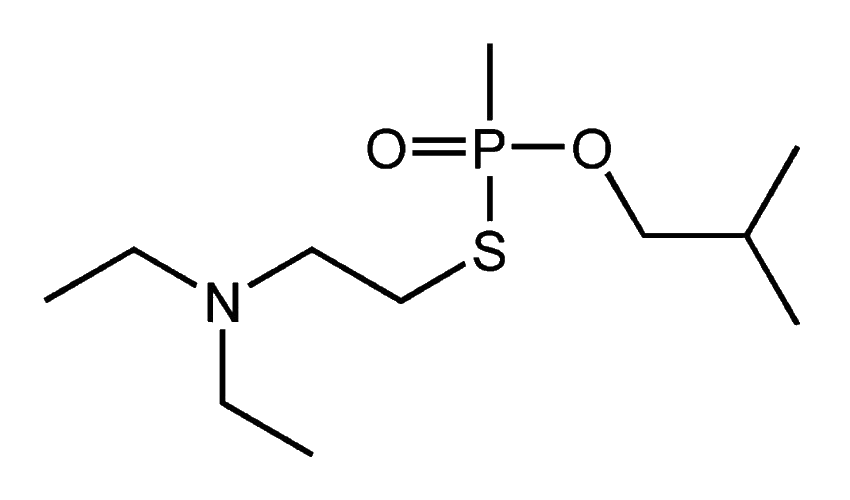
O-(iso-Butyl) S-(2-diethylaminoethyl) methylphosphonothiolate [VR, Russian VX, VR is an isomer of VX] - C11H26NO2PS
VR is closely related (it is an
isomer) to the better-known VX nerve agent. VR has similar lethal
dose levels to VX (10 – 50 mg), as well as being similar in
appearance. However, due to usage of diethylamino radicals
instead of diisopropylamino it is more prone to decomposition.
The former are worse at sterically protecting the nitrogen atom
from attacking either phosphorus or the α-carbon atom adjacent to
sulfur than the latter. Its instability is regarded as a reason
why VX was preferred in the West.
According to Russian CW developer Vil Mirzayanov, in the late
1980s a group of State
Scientific Research Institute for Organic Chemistry and
Technology (GosNIIOKh) chemists led by Georgiy Drozd
prepared a scientific report that Substance 33 had much lower
shelf life than VX. The report, writes Mirzayanov, caused 'panic'
in the institute top management and the military representative
office, and later was met with administrative resistance. This
finding was independently verified by another chemist Igor
Revelskiy but his report was not approved either.
Following the poisoning of Sergei and Yulia Skripal, former head
of the GosNIIOKhT security department Nikolay Volodin said in an
interview to Novaya Gazeta that Substance 33 was decomposing too
quickly in combat conditions, and implied that this fact may have
influenced the decision to continue research on the Novichok
program.[12]
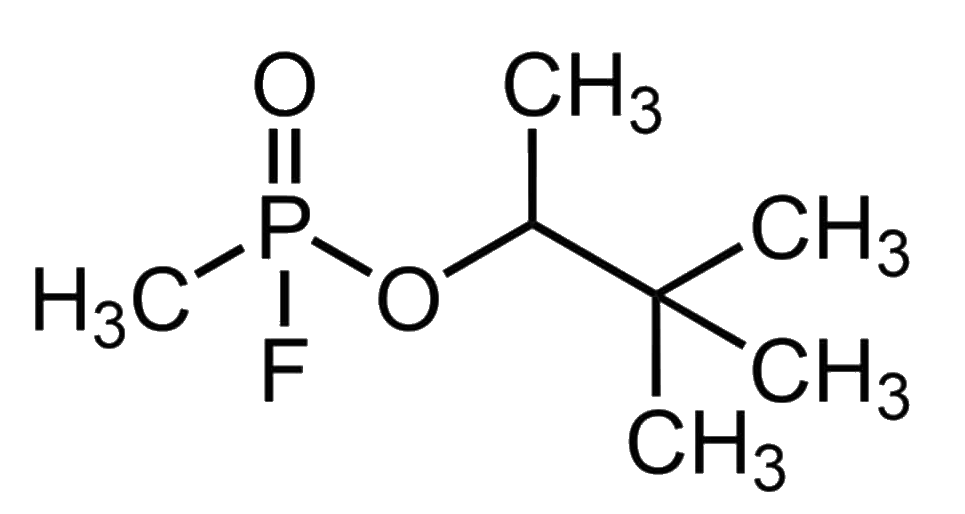
O-Pinacolyl methylphosphonofluoridate [Soman, GD] - C7H16FO2P
When pure, soman is a volatile, corrosive, and colorless liquid with a faint odor like that of mothballs or rotten fruit. More commonly, it is a yellow to brown color and has a strong odour described as similar to camphor. The LCt50 for soman is 70 mg·min/m3 in humans.It is both more lethal and more persistent than sarin or tabun, but less so than cyclosarin.
GD can be thickened for use as
a chemical spray using an acryloid copolymer. It can also be
deployed as a binary chemical weapon;
its precursor chemicals are methylphosphonyl difluoride and a
mixture of pinacolyl alcohol and an amine.
O,O-diethyl S-[2-(diethylamino)ethyl] phosphorothioate [VG, Amiton, Tetram] - C10H24NO3PS
VG has a toxicity of about 1/10
that of VX, i.e. similar to that of sarin. VG was originally
developed as an acaricide and insecticide.
Propan-2-yl ethylphosphonofluoridate [Ethyl sarin, E1209, GE] C5H12FO
Odourless and colourless to yellow-brown liquid. The effect of exposure to Ethyl sarin depends on the amount of the agent, route and duration of the exposure. The symptoms will appear within a few seconds after inhalation exposure to the vapour form and from a few minutes to 18 hours after exposure to the liquid form. Ethyl sarin may be absorbed quickly and easily. When dispersed as a vapour or aerosol, or absorbed on dust, it is readily absorbed through the respiratory tract and conjunctivae. Absorption is most rapid and complete through the respiratory tract. Aerosols and liquids are also absorbed through skin. Vapours may be absorbed through skin if at very high concentrations. Liquid droplets or even vapor may persist in a victim's clothes after minutes to hours of exposure which may lead to cross-contamination of others.
Following local exposure, symptoms may include: rhinorrhoea and hyperaemia of nasal mucosal membranes, miosis - sometimes unequal, hyperaemia of conjunctivae, excessive sweating at site of exposure, frontal headache, eye pain on focusing, slight dimness of vision, occasional nausea and vomiting, tightness of chest, sometimes with prolonged wheezing, expiration suggestive of broncho-constriction or increased secretion and cough. Fasciculations (muscle twitching) at the site of exposure to liquid.Following systemic absorption: tightness in chest with prolonged wheezing expiration suggestive of bronchoconstriction or increased secretion, dyspnoea, slight pain in chest, increased bronchial secretion, cough, pulmonary oedema, cyanosis, anorexia, nausea, vomiting, abdominal cramps, epigastric and substernal tightness with heartburn and eructation, diarrhoea, tenesmus; involuntary defaecation, increased/excessive sweating, increased/excessive salivation, increased/excessive lacrimation, bradycardia, slight miosis occasionally unequal, blurring of vision, involuntary urination, easy fatigue, mild weakness, muscular twitching, fasciculations, cramps, generalized weakness, including muscles of respiration, with dyspnoea and cyanosis
S-[2-(Diethylamino)ethyl] O-ethyl methylphosphonothioate [Edemo, VM], C9H22NO2PS
Similar lethal dose levels to
VX (between 10 and 50 mg) and have similar symptoms and method of
action to other nerve agents. Like most of the agents in the
V-series (with the exception of VX), VM has not been extensively
studied outside of military science. Little is known about this
chemical compound other than its chemical formula.
It is commonly theorized that the so-called "second-generation" V
series agents came from a Cold War era Russian chemical weapons
development program. They may have been developed sometime between
1950 and 1990. They have similar lethal dose levels to VX (between
10 and 50 mg) and have similar symptoms and method of action to
other nerve agents that act on cholinesterase. The treatment
remains the same, but the window for effectively treating second
generation V series seizures is shorter. In addition to the
standard seizures, some of the second generation V series agents
are known to cause comas.
![O-butyl S-[2-(diethylamino)ethyl] methylphosphonothioate](graphics/O-butyl%20S-[2-%28diethylamino%29ethyl]%20methylphosphonothioate.png)

![O,O-diethyl S-[2-(diethylamino)ethyl] phosphorothioate](graphics/O,O-diethyl%20S-[2-%28diethylamino%29ethyl]%20phosphorothioate.png)

![S-[2-(Diethylamino)ethyl] O-ethyl methylphosphonothioate](graphics/S-[2-%28Diethylamino%29ethyl]%20O-ethyl%20methylphosphonothioate.png)