Sternutators
When everything is covered with yellow pollen, many people have fits of sternutation.
Anon
Sternutators cause vomiting, respiratory irritation and sneezing, their purpose is to incapacitate rather than to kill the enemy, as such they are sometimes regarded as riot control agents rather than as CW agents. The effects of these agents is short-lived.
Dianisidine
chlorosulphonate [Niespulver, dianisidine
chlorosulfate] - C14H16N2O2ClSO3 -
A colorless or white solid. It was first used by the Germans in WWI, as a shell filling with an explosive dispersant, rather than dispersing the agent, it incinerated it. This agent is regarded as not very effective, until about 1940 it was still the major ingredient of joke sneezing powder, in some parts of the world, but was banned as early as 1919 in the USA.
Diphenylchloroarsine [Chlorodiphenylarsine,
Blue cross, Sternite, DA, Clark I] - (C6H5)2AsCl
-
A colorless crystalline solid, or a
dark-brown liquid. Strongly irritating to skin and eyes, and can
cause vomiting. Toxic by ingestion and inhalation.
Diphenylcyanoarsine [Sternite,
DC, CDA, Clark II, Chlor-Arsen-Kampfstoff 2] - (C6H5)2AsCN
-
A colourless liquid, or crystalline
solid, melting point of 31 °C, odourless or fruity odour. Low
solubility in water, water contact causes slow decomposition.
Diphenylaminechloroarsine [10-Chloro-5,10-dihydrophenarsazine,
DM, Adamsite] - (C6H4)2NHAsCl -
An odourless crystalline compound with
a very low vapour pressure. The colour of the crystals ranges from
bright yellow to dark green depending on the purity. It is readily
soluble in some organic solvents (e.g., acetone, dichloromethane),
but nearly insoluble in water. In vapour form it appears as a canary
yellow smoke. Usually dispersed as an aerosol, making the upper
respiratory tract the primary site of action. Although the effects
are similar to those caused by typical riot control agents (e.g.
CS), they are slower in onset but longer in duration, often lasting
for 12 or more hours. After a latency period of 5-10 minutes
irritation of the eyes, lungs and mucous membranes develops followed
by headache, nausea and persistent vomiting.
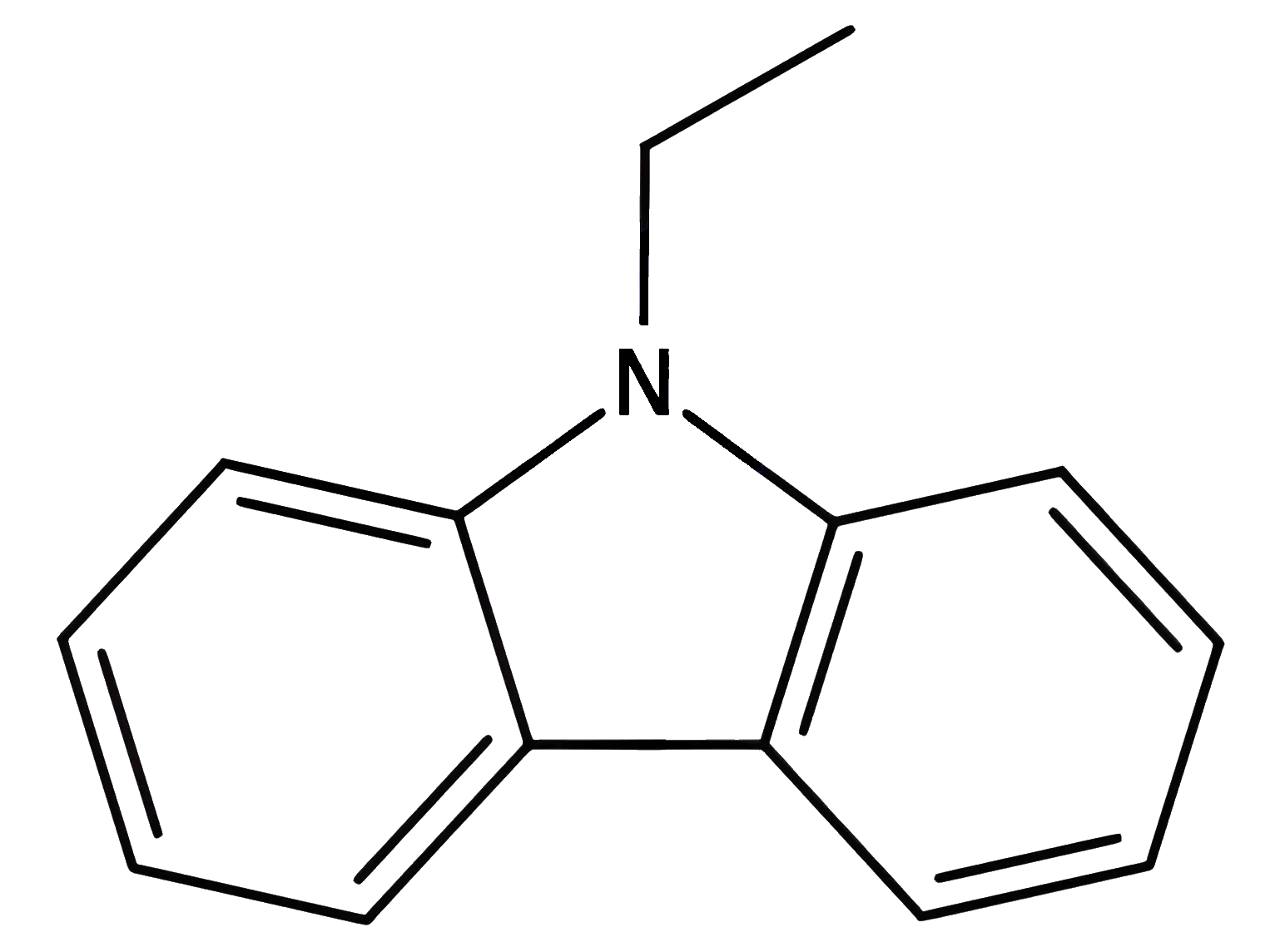
Ethylcarbazole [N-ethylcarbazole,
9-Ethylcarbazole, 9-Ethyl-9H-carbazole] - (C6H4)2NC2H5
-
A brown solid. Causes eye, skin,
respiratory and digestive tract irritation. No longer classified as
a CW agent, it is used in the electronics industries.
Ethyldibromoarsine -
[dibromoethylarsine; Yellow Cross] C2H5AsBr2
-
This colourless volatile liquid,
reportedly smells like rotting fruit. Vapours irritate eyes and
skin. Very toxic by inhalation. Denser than water and vapours are
heavier than air.
Ethyldichloroarsine [Dick,
EDED, TL-214; Dichloroethylarsine, Ethyldichloroarsine,
dichloro(ethyl)arsane, Ethylarsenic dichloride, Ethylarsonous
dichloride] - C2H5AsCl2 -
This colourless volatile liquid,
reportedly smells like rotting fruit. Vapours irritate eyes and
skin. Very toxic by inhalation. Denser than water and vapours are
heavier than air. Ethyldichloroarsine has the same structure as
ethyldibromoarsine, but with the bromine atoms replaced by chlorine
atoms.
Methyldichloroarsine [Methyldick,
MD] - CH3AsCl2 -
This colourless volatile liquid is a
highly toxic vesicant. Respiratory
symptoms may be delayed for 3 to 5 days.
Phenyldichloroarsine [Sternite]
- C6H5AsCl2 -
An odourless, colourless to brownish
liquid with an oily texture. When impure, it can have a
"horseradish" or garlic-like odor.
Symptoms may worsen or appear up
to 32 hours after the initial exposure.