
Novichok Agents
It is now clear that Mr Skripal and his daughter were poisoned with a military-grade nerve agent of a type developed by Russia. This is part of a group of nerve agents known as 'Novichok'. Based on the positive identification of this chemical agent by world-leading experts at the Defence Science and Technology Laboratory at Porton Down; our knowledge that Russia has previously produced this agent and would still be capable of doing so; Russia's record of conducting state-sponsored assassinations; and our assessment that Russia views some defectors as legitimate targets for assassinations; the Government has concluded that it is highly likely that Russia was responsible for the act against Sergei and Yulia Skripal. Mr Speaker, there are therefore only two plausible explanations for what happened in Salisbury on 4 March. Either this was a direct act by the Russian State against our country. Or the Russian government lost control of this potentially catastrophically damaging nerve agent and allowed it to get into the hands of others.
Theresa May
Despite what is frequently stated in the western press, there is no single substance known as Novichok. Novichok agents were developed in the 1950s through to the 1990s. They were designed as part of a Soviet programme code-named FOLIANT. The agents were developed at the GosNIIOKhT (State Research Institute of Organic Chemistry and Technology), in Moscow, by the Soviet Union and Russia between 1971 and 1993.The first three synthesised were Substance -33, A-230 and A-232. The structure of these substances and synthesized agents was similar to other nerve agents. Novichok-5 was based on A-232 structure, being the first binary type of Newcomer agents in year 1989. During what was described as a pesticide research program hundreds of Novichok agents were synthesized but only Substance-33, A-230, A-232, A-234, Novichik-5 and Novichok-7 are known to be weaponised. Potentially some twenty-five agents are possible. The objectives were to produce agents that would penetrate NATO protective equipment, be undetectable by existing NATO equipment, bypass the Chemical Weapons Convention, and be more potent than previous nerve agents. A number of the Novichok agents were developed to be binary weapons, that is that two chemicals that were not covered by the current regulations could be combined at the point of use to produce the agent itself. There is some confusion, even in the scientific press, over the naming and chemical structures of various Novichoks. Effects are similar to other nerve agents, although, with the exception of Substance 33, they are believed to be significantly more toxic.
Novichok agents are commonly described as the fourth generation of Nerve agent in military classification, according to its effects in humans. They are colourless, tasteless, and odourless, at normal ambient temperatures. Novichok agents are mostly in liquid form, but they can be converted into a dusty formulation by adsorbing droplets into a solid carrier like silica gel, talc, fuller's earth or pumice. The scientists who developed the nerve agents claim they are the deadliest ever made, with some variants possibly five to eight times more potent than VX, and others up to ten times more potent than soman. Novichok-5 and Novichok-7 are reported to act very rapidly, penetrating the skin and respiratory system. Symptoms range from sweating and twitching to seizures and an inability to breathe.Novichoks are, generally, even less volatile than VX-nerve agents, which means they are the slowest to evaporate from liquid form into vapour. They are non-volatile compounds (NVOC) and highly persistent. Exposure to Novichok agents is fatal unless aggressively managed. Exposure symptoms are pinpoint pupils, runny nose, breathing difficulties, convulsions, sweating, nausea, vomiting, seizures, loss of consciousness, and ultimately death. Long-term neurological problems are likely for those that have been exposed to Novichoks.
Novichok agents came to public attention after they were used to poison opponents of the Russian government, including the Skripals and two others in Amesbury, UK (2018), and Alexei Navalny (2020), but civil poisonings with these substances have been known since at least 1995. Novichoks had been known of by western intelligence since the early 1990s.
In November 2019, the Organisation for the Prohibition of Chemical Weapons (OPCW), which is the executive body for the Chemical Weapons Convention (CWC)(pdf), added the Novichok agents to "list of controlled substances" of the CWC "in one of the first major changes to the treaty since it was agreed in the 1990s" in response to the 2018 poisonings in the UK.
There has been some disagreement about the chemistry and structure of novichoks, but the following are pretty much agreed upon.
1,1,3,3-tetraethyl-2-[fluoro(methoxy)phosphoryl]guanidine [A-262, Novichok-7] - C10H23FN3O2P - Is reportedly a solid rather than a volatile liquid as with most nerve agents, and in order to weaponise it successfully, it had to be converted to a fine powder form that could be dispersed as a dust. A262 was developed in the Soviet Union under the FOLIANT program and is one of the group of compounds referred to as Novichok agents that were revealed by Vil Mirzayanov. Mirzayanov gives little specific information about A-262, stating that it is highly toxic, but no figures are given to compare it to other related agents. It is reportedly a solid rather than a volatile liquid as with most nerve agents, and in order to weaponise it successfully, it had to be milled into a fine powder form that could be dispersed as a dust.
Ethyl N-[(1E)-1-(diethylamino)ethylidene]-phosphoramidofluoridate [A-234] - C8H18FN2O2P - The binary analogue of this is known as Novichok-7. In March 2018, the Russian ambassador to the UK, Alexander Yakovenko, claimed to have been informed by British authorities that A-234 had been identified as the agent used in the poisoning of Sergei and Yulia Skripal in Salisbury. Vladimir Uglev, a Russian chemist who worked on the Novichok series of compounds, said he was "99 percent sure that it was A-234" in relation to the 2018 Amesbury poisonings that resulted in the death of Dawn Sturgess and the poisoning of another British national, noting its unusually high persistence in the environment.According to a classified report by the United States Army National Ground Intelligence Center, the agent designated as A-232 and its ethyl analog A-234, developed under the FOLIANT program, were "as toxic as VX, as resistant to treatment as soman, and more difficult to detect and easier to manufacture than VX".
No certain data on toxicity exist but it is estimated that the median lethal concentration of A-234 is 7 mg/m3. This means that half of 70 kg individuals under slight physical activity – breathing 15 litres of air per minute – would die
Methyl-(bis(diethylamino)methylene)phosphonamidofluoridate [A-242, 1,1,3,3-tetraethyl 2-[fluoro(methyl)phosphoryl]guanidine] - C10H23FN3OP - is reportedly a solid rather than a volatile liquid as with most nerve agents, and in order to weaponise it successfully, it had to be converted to a fine powder form that could be dispersed as a dust. Vil Mirzayanov gives little specific information about A-242, stating that it is highly toxic but no figures are given to compare it to other related agents. It is reportedly a solid rather than a volatile liquid as with most nerve agents, and in order to weaponise it successfully, it had to be milled into a fine powder form that could be dispersed as a dust
Methyl [(1E)-1-(diethylamino)ethylidene]phosphoramidofluoridate [A-232, Novichok-5] - C7H16FN2O2P -The binary analogue is known as Novichok-5 .A-232 is reportedly slightly less potent as a nerve agent compared to some of the other compounds in the series such as A-230 and A-234, having similar potency to the older nerve agent VR. However it proved to be the most versatile agent as it was chemically stable and remained a volatile liquid over a wide temperature range, making it able to be used in standard chemical munitions without requiring special delivery mechanisms to be developed.
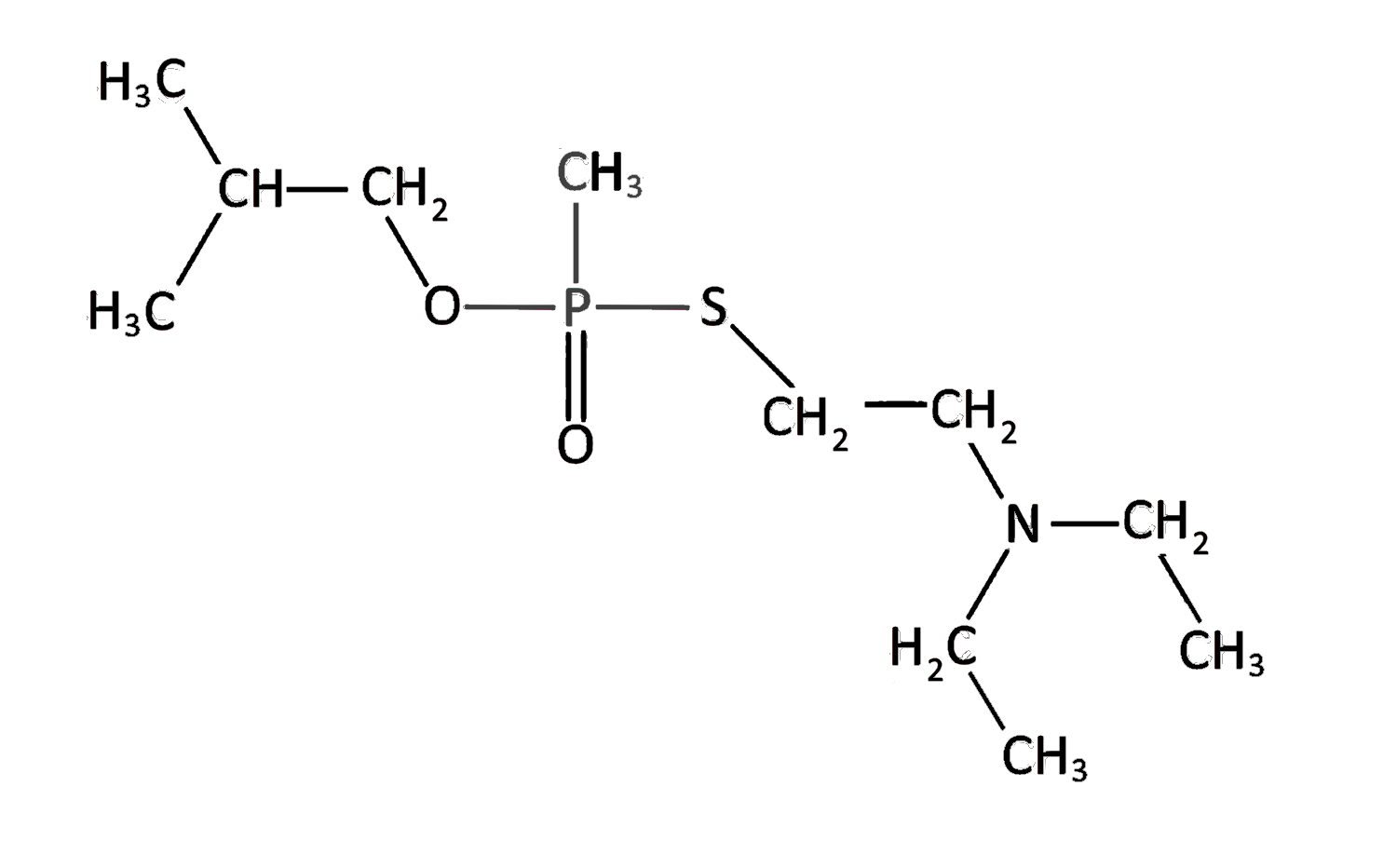
N,N-diethyl-2-(methyl-(2-methylpropoxy)phosphoryl)sulfanylethanamine [Substance 33, Russian VX, Soviet V-gas, Substance 33, R-33, Agent "November", VR] - C11H26NO2PS - VR is a "V-series" unitary nerve agent and an isomer of VX. It is a clear, amber-coloured odourless liquid. VR has similar lethal dose levels to VX (between 10 & 50 mg).
N-[(1E)-1-(Diethylamino)ethylidene]-P-methylphosphonamidic fluoride [A-230, 84] - C7H16FN2OP - The human median lethal dose or LD50 is estimated to be less than 0.1mg. However it is thought to be less suitable for weaponisation than other agents such as A-232 and A-234, due to issues with the liquid agent exhibiting low volatility and solidifying at low temperatures, as well as poor stability in the presence of water.
![1,1,3,3-tetraethyl-2-[fluoro(methoxy)phosphoryl]guanidine](graphics/1,1,3,3-tetraethyl-2-[fluoro%28methoxy%29phosphoryl].png)
![Ethyl N-[(1E)-1-(diethylamino)ethylidene]-phosphoramidofluoridate](graphics/Ethyl%20N-[%281E%29-1-%28diethylamino%29ethylidene]-phosphoramidofluoridate.png)

![Methyl [(1E)-1-(diethylamino)ethylidene]phosphoramidofluoridate](graphics/Methyl%20[%281E%29-1-%28diethylamino%29ethylidene]phosphoramidofluoridate.png)
![N-[(1E)-1-(Diethylamino)ethylidene]-P-methylphosphonamidic fluoride](graphics/N-[%281E%29-1-%28Diethylamino%29ethylidene]-P-methylphosphonamidic%20fluoride.png)